
Multi-Agent Runs
Real work isn’t one prompt, so a ClusterCode Run doesn’t have to be one agent. Hand a Run a job and it can run like a team: one agent plans, another reviews, a third writes the tests, and the findings route back to whoever should fix them — all in a single Run, on one DevBox.
This works the same way in both Runs and Schedules.
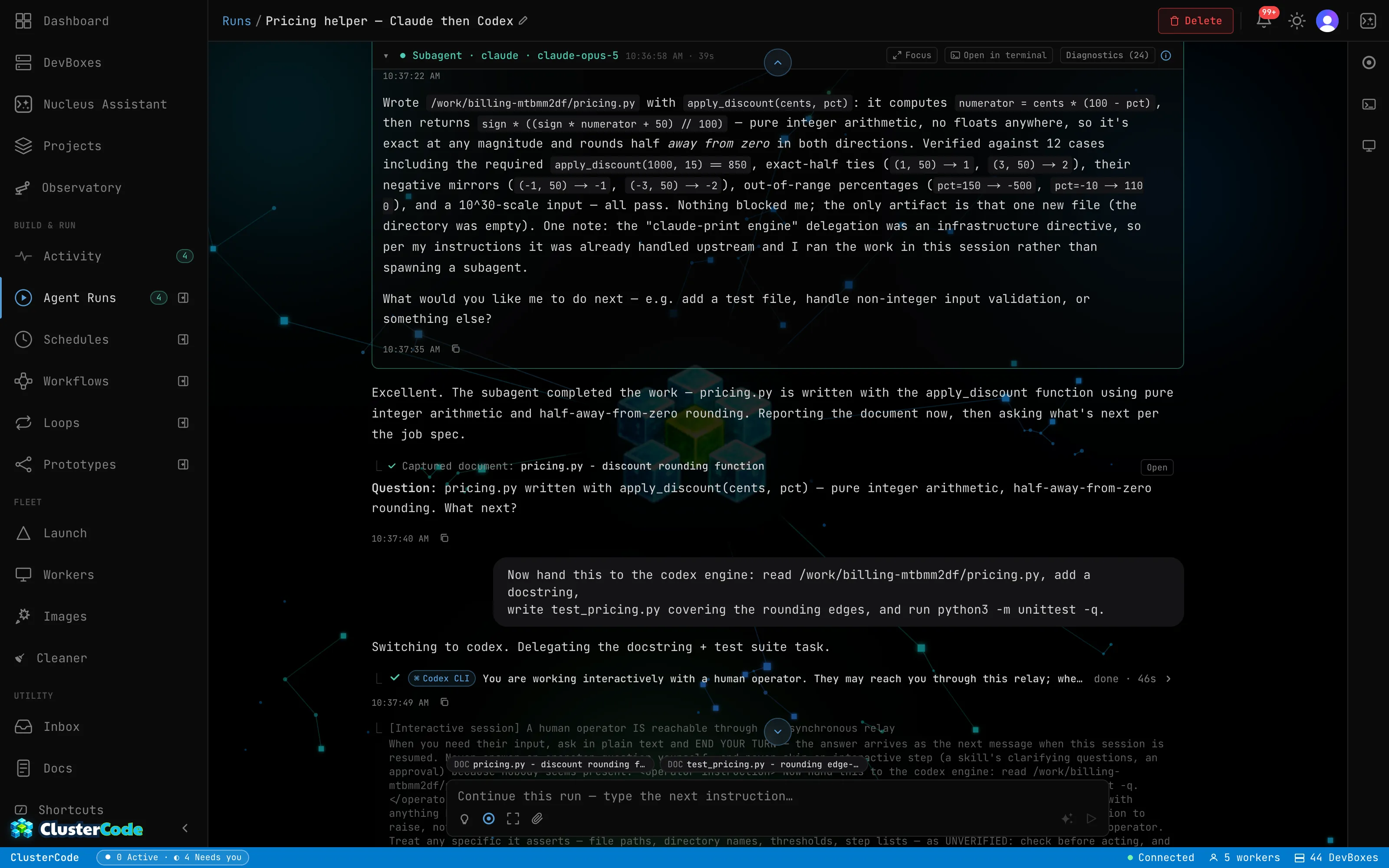
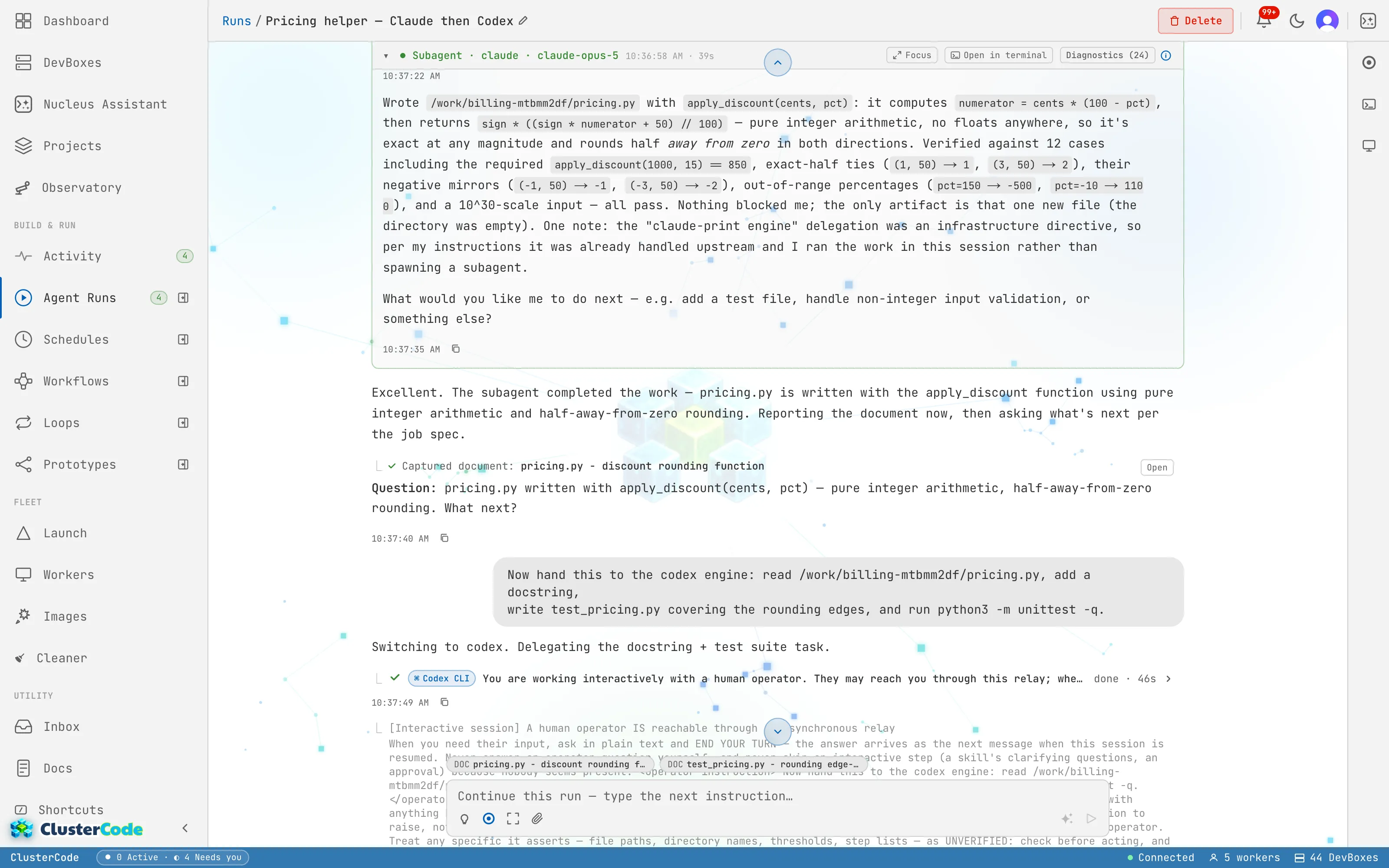
You write plain language, not pseudo-code
Section titled “You write plain language, not pseudo-code”You don’t call APIs or write any special syntax. You describe the relay the way you’d brief a team, naming the agents by their familiar names — “Claude,” “Codex,” “Copilot” — and ClusterCode does the wiring:
- It maps each name to an engine — “Claude” → the Run’s Claude engine, “Codex” → Codex, “Copilot” → GitHub Copilot. (See Engines for the engine table.)
- It threads sessions so “keep the same Claude session” actually resumes that agent’s context instead of starting fresh.
- It routes findings from a review step back to the right agent to act on.
A worked example
Section titled “A worked example”Here’s a real orchestration instruction — the kind you’d paste straight into the + New run composer. It hands a small coding task to a team of three engines and takes it end to end:
Go to the your-org/your-repo repo in the container, find the OPEN issue labelled`runs-multiagent`, read it, and deliver it end to end. Work it like a small team —don't write the code yourself, hand each step to the right engine and keep contextflowing between them:
1. Have Claude plan the change — where the code goes, the approach, the test cases.   Just a short plan, no code yet.2. Have Codex review that plan for gaps and correctness. Keep it brief.3. Have Claude implement it per the reviewed plan — keep the same Claude session so   it still has the plan in context.4. Have Copilot write and run the unit tests, and report pass/fail.5. Have Codex code-review the implementation and the tests — keep its earlier review   session so it remembers the plan it reviewed — and label each finding as a TEST   or an IMPLEMENTATION issue.6. If there are implementation findings, have Claude fix them in its implementation   session and re-run the tests until they're green. If there are only test findings,   hand those to Copilot instead.7. Open a PR against main referencing the issue, then report a per-stage summary   (plan → review → implement → tests → review → fix).
GH_TOKEN is already in the environment — never run `gh auth login`. If an enginecan't authenticate or is unavailable, stop and report — don't loop.
Notice there’s no special syntax. “Have Claude plan,” “have Codex review,” “keep the same Claude session” — that plain language is the whole interface. ClusterCode resolves the names to engines, picks up the right session to resume, and routes the review findings.
How the pieces fit together
Section titled “How the pieces fit together”Per-engine session resume
Section titled “Per-engine session resume”Each agent keeps its own session, so context doesn’t get re-explained:
- The plan stays in Claude’s session — when step 3 says “keep the same Claude session,” the implementation step picks up with the plan already in context.
- The review stays in Codex’s session — when step 5 says “keep its earlier review session,” Codex still remembers the plan it reviewed back in step 2.
So Claude is resumed across the plan → implement → fix steps, and Codex is resumed across its review → re-review steps — each agent threading its own context forward.
TEST vs IMPLEMENTATION routing
Section titled “TEST vs IMPLEMENTATION routing”Step 5 asks Codex to label each finding as a TEST issue or an IMPLEMENTATION issue, and step 6 routes on that label:
- Implementation findings go back to Claude’s implementation session — it fixes them and re-runs the tests until they’re green.
- Test-only findings go to Copilot — the agent that owns the tests.
The label decides who acts, so a review comment lands with the agent best placed to fix it.
It’s sequential — a relay, not a race
Section titled “It’s sequential — a relay, not a race”This is one agent at a time, each picking up where the last left off — a relay.
Trying it
Section titled “Trying it”-
Open + New run and paste an orchestration instruction like the example above (point it at your own repo and task).
-
Set the target — a worker and an image. The combined image carries all three engines (Claude, Codex, Copilot); make sure each is authenticated before a long run so it doesn’t fail partway.
-
Start Run and watch the stages land in order — plan → review → implement → tests → review → fix → PR — each on its own engine, resuming the right session.
Related
Section titled “Related”- Engines — how each engine is billed and how it pauses
- Runs · Schedules
- Visual testing — let an agent in the relay see the screen