
Prototyping
A Prototype is one prompt raced across several agents at once. You write a single brief — “build a marketing site”, “add dark mode to the settings page” — pick which engine+model contenders should attempt it, and ClusterCode runs the same brief through each one autonomously, each on its own branch in its own DevBox. When they finish, you compare the results side by side, preview any contender live, and promote the one you like — which opens a pull request from its branch.
It’s “vibe coding” packaged for professionals: instead of committing to one model and hoping, you let Claude, Codex, and Copilot each take a swing at the same goal and let the results decide.
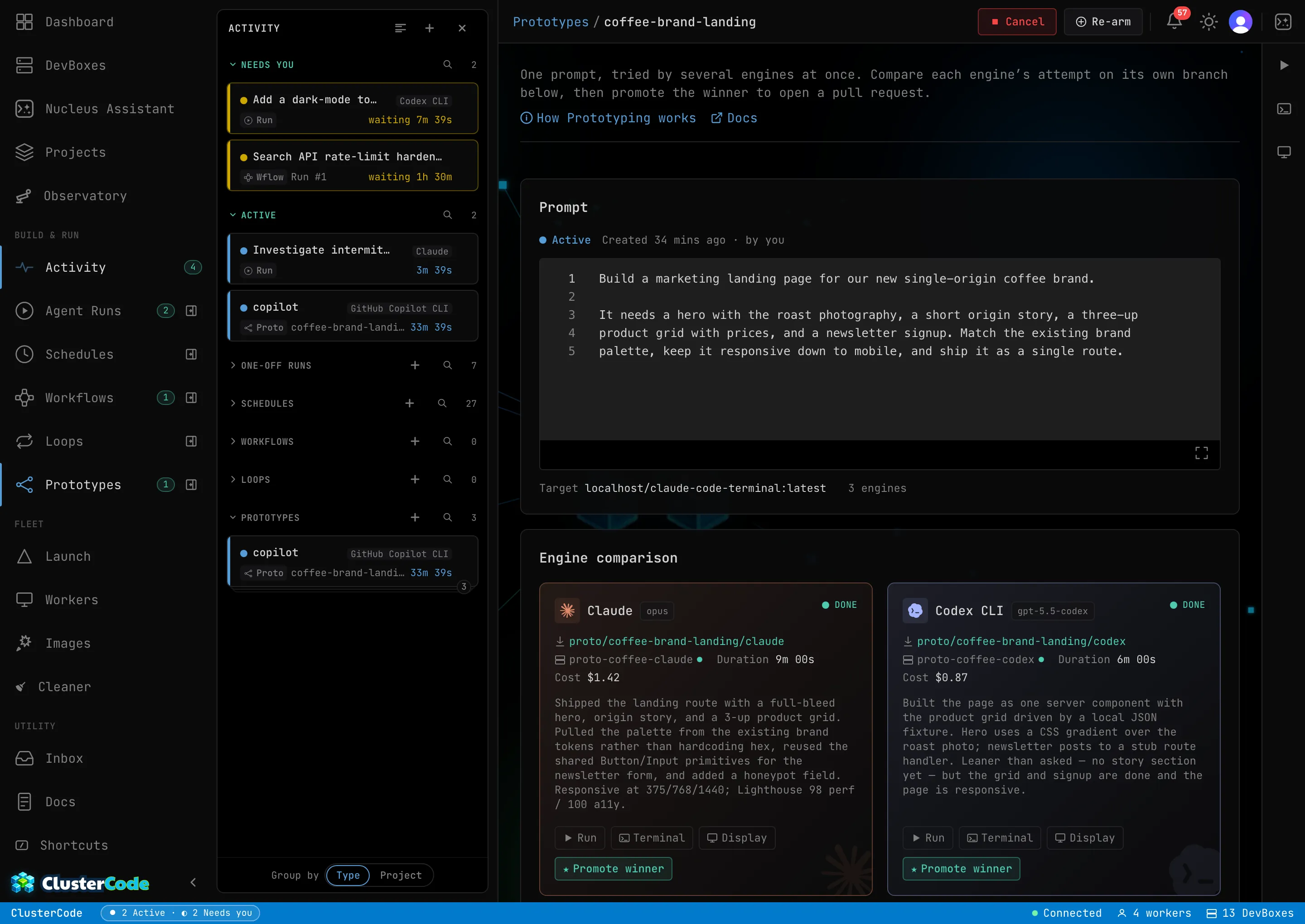
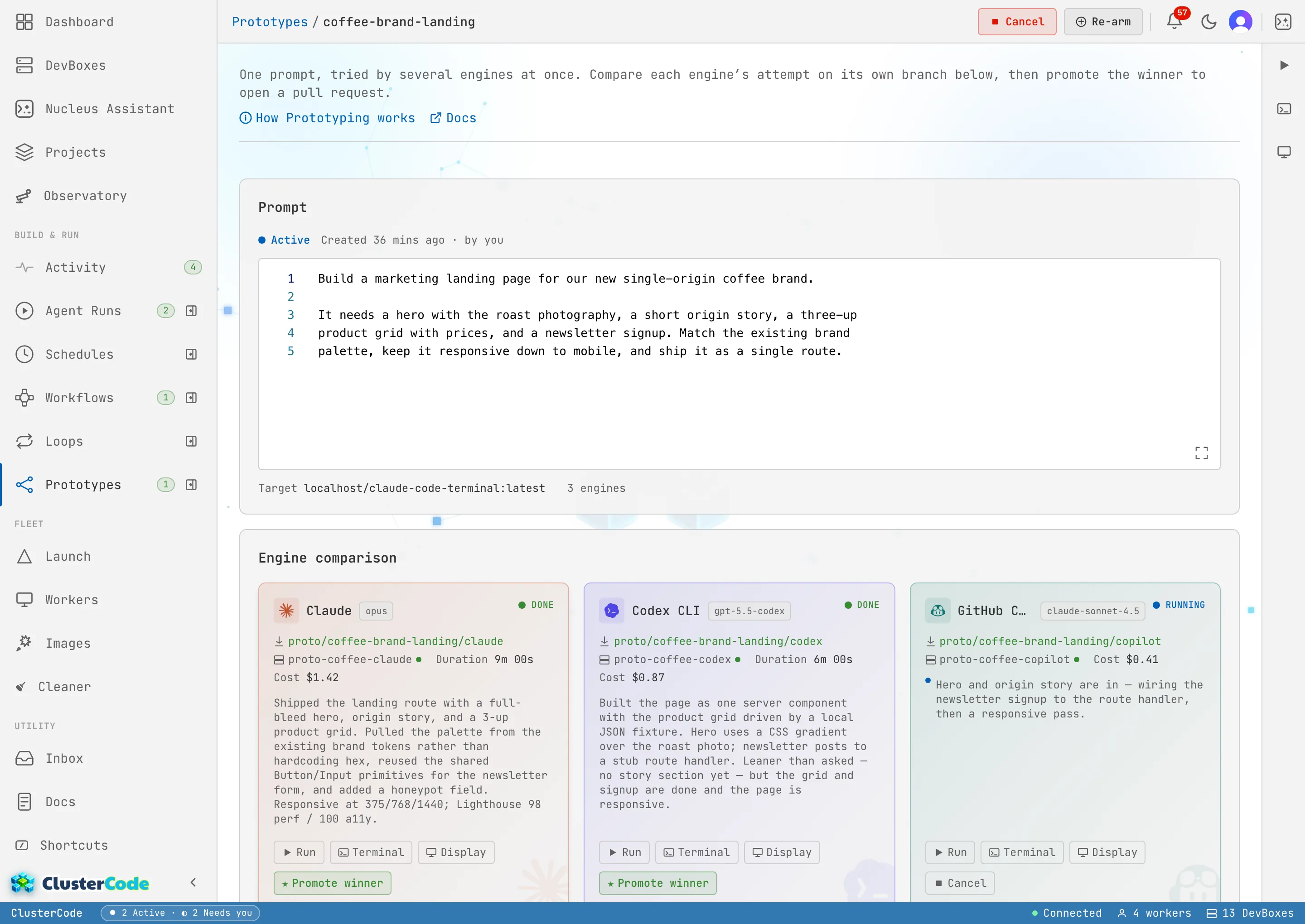
One prompt, N contenders
Section titled “One prompt, N contenders”You define a prototype once — the prompt, the target (worker + image or DevBox), the repository, and the security profile — and then choose the contenders: a list of engine + model pairs. The same CLI with two different models is a valid matchup, so “Claude Sonnet vs Claude Opus vs Codex GPT-5” is a legal race.
Each contender becomes an independent, autonomous Run:
- It gets its own branch, named
proto/<slug>/<engine>(with-<model>appended when the same engine appears more than once, so the branches never collide). - It works in its own DevBox, cloned fresh from your repository.
- It runs to completion on its own — no turn-by-turn shepherding — committing its work to its branch locally as it goes. Nothing is pushed during the race: your remote never sees N speculative branches, and no push credentials are needed until you promote.
Nothing about the contenders is shared at runtime: they don’t see each other’s work, so each result is an honest, independent attempt at your brief.
How it works
Section titled “How it works” your brief (one prompt) │ ┌───────────────┼───────────────┐ ▼ ▼ ▼ claude · opus codex · gpt-5 copilot · sonnet ← contenders ┌──────────┐ ┌──────────┐ ┌──────────┐ (engine+model) │ DevBox A │ │ DevBox B │ │ DevBox C │ each isolated │ branch A │ │ branch B │ │ branch C │ commits stay local └────┬─────┘ └────┬─────┘ └────┬─────┘ ▼ ▼ ▼ done done failed │ │ │ └───────┬───────┘ (error surfaced ▼ on its card — compare · preview · pick fix & resume, │ or let it lose) ▼ ★ promote the winner │ winner's run resumes → pushes its branch → opens the PR losers' DevBoxes torn down · the race never mergesMore contenders than your plan’s run slots? The extras wait as queued and enter the race automatically as slots free — see the next section.
Want the gears? How a Prototype race works walks one race end to end — admission, isolation, the parent’s verdict, fix & resume, and promotion.
Queued admission — concurrency is respected, not exceeded
Section titled “Queued admission — concurrency is respected, not exceeded”Contenders don’t all start at once if your plan won’t allow it. Each prototype respects your plan’s concurrent-run limit the same way every other run does: children that can’t get a run slot wait as queued and are admitted automatically, oldest-first, as slots free up.
Each card tells you where it stands: a running card shows a live latest-activity line, a queued card explains it’s waiting for a run slot (with the plan’s concurrency and its queue position), and a done card shows the finished result.
Compare — the comparison cards
Section titled “Compare — the comparison cards”The detail page lays out the contenders as equal comparison cards in a strip, so you’re weighing like against like. Each card carries, top to bottom:
- the engine + model,
- the branch, the duration, and the cost so far,
- a status pill (queued · running · done · failed),
- a summary block — the agent’s own end-of-run summary when it’s done, or the live latest-activity line while it’s still running, or the queue explanation while it waits, and
- the preview and promote actions.
Because each contender is a real Run, its cost and summary are read straight from the run — the card never invents its own numbers.
Preview any contender, one at a time
Section titled “Preview any contender, one at a time”Any card can be opened in the shared side panel — the same Run / Terminal / Display panel that Runs and Loops use. Preview in Display opens the contender’s live desktop, Preview in Terminal opens its shell, and clicking the card opens its Run transcript. The Run tab’s header selector switches between sibling contenders, so you can flip from one engine’s transcript to another’s without leaving the panel.
Preview is one contender at a time by design — the display relay focuses a single DevBox. That’s why the contenders’ containers are kept alive after they finish: a done prototype is still fully inspectable until you decide.
Promote the winner → a pull request
Section titled “Promote the winner → a pull request”When you’ve picked a winner, Promote it. Promoting resumes that contender’s run with a single injected instruction: push your branch and open a pull request. The agent that did the work — with its full context intact — pushes the branch it’s been committing to and opens the PR, and the prototype records the resulting PR URL. This is the one moment push credentials are needed: a GitHub personal access token saved in Settings.
Promotion is a creator-only action — the person who started the prototype decides the winner.
Losers are retired; the lifecycle stays tidy
Section titled “Losers are retired; the lifecycle stays tidy”- Promote tears down the losing contenders’ DevBoxes — the compute is freed, and the winner keeps its container so the resumed run can push and open the PR from it.
- Cancel stops a still-racing prototype: running contenders are aborted, queued ones are dropped, and their containers are torn down.
- Archive a finished prototype once you’re done comparing: its preview containers are torn down (Terminal/Display previews stop working) and it moves out of the main list. The record stays.
- Delete permanently removes a finished prototype and every run its contenders produced — execution records and full traces included. Anything pushed to GitHub (a promoted branch or PR) stays. The confirm dialog spells this out; it can’t be undone.
A prototype counts as active only while contenders are still working (or queued). The moment the race finishes — every contender done, failed, or cancelled — it stops counting against the per-plan cap below, even though its preview DevBoxes stay alive for inspection. Container load is governed by your container limits; the prototype cap bounds concurrent races, not finished results.
Availability
Section titled “Availability”Prototyping is available on every plan. Two per-tier caps apply:
- Active prototypes — how many races can be in flight (contenders still working or queued) at once — see Plans & Limits. A finished prototype frees its slot immediately — you never have to archive or delete a result just to start the next race.
- Contenders per prototype — how many engine+model pairs a single prototype may race — see Plans & Limits.
Concurrency itself is still governed by your plan’s concurrent-run limit — the queueing above is how the Free and Starter tiers experience a race with more contenders than run slots.
Next steps
Section titled “Next steps”- Create a Prototype — the practical walkthrough
- How a Prototype race works — the lifecycle deep-dive
- Runs — what each contender looks like under the hood
- Engines — the Claude / Codex / Copilot runtimes you race
- Loops — the sibling feature: one goal, iterated until verified
- Plans & Limits — the per-tier caps in full